

In this article I’ll cover and rank the best “Great Taking” (expropriation) hedges.
As always, none of this should be considered as legal or investment advice.
You should always follow the law as this has always worked out great, especially for those who “sold” their gold to the US government after executive order 6102 was issued.
Executive Order 6102, signed by President Franklin D. Roosevelt on April 5, 1933, prohibited the "hoarding" of gold coins, bullion, and certificates in the U.S. to combat the Great Depression (the great rug-pull of liquidity), requiring citizens to exchange their gold for paper currency at a fixed price.
Citizens were forced to exchange their gold for paper at ~$20.67 per ounce and after they did, the government revalued gold to ~$35 per ounce, effectively scamming the obedient plebs.
This order was repealed in 1974, restoring private ownership of gold.
For more context on the “Great Taking”, watch this documentary on odysee.
I’ll give you the TL;DR here.
Definition: A jurisdiction-synchronized legal/financial stack (custody law + rehypothecation + bail-ins + CSD plumbing + digital ledgers) that allows seizing collateralized claims during a systemic event.
Scope: Anything inside the custody/tiering chain (bank deposits, brokerage assets, CSD-registered securities, pooled gold, mortgages, money funds) is claim-on-a-claim, not direct property.
Exemptions in practice: Only outside-chain assets resist (physical bearer, lien-free land in your name, and resilient self-custody digital assets with your keys).
Enabling Mechanisms (already installed):
Custody law: Title sits at CSD (Central Securities Depository)/nominee; beneficial owner = entitlement holder, subordinated in stress.
Rehypothecation: Chains turn your assets into counter-party collateral.
Bail-ins/Resolution: Banks/brokers convert claims to equity/IOUs; stays and moratoria freeze transfers.
Emergency powers: Harmonized templates to override contract terms “for stability”.
Digital rails: CBDC/stable/tokenized deposit scaffolds = instant perimeter control (KYC spend, tax split, revocation).
Conclusion: The tooling exists. You only need a narrative ignition.
Coincidentally, the law that allows for a Great Taking is in place in every country on Earth.
If you play fiat games, you have to think about the scenario in which the system fails.
Grounding: What is being seized in a “Great Taking” scenario?
In a “Great Taking” frame, the Controllers use legal + plumbing + tech to seize or haircut:
Bank deposits (via bail-ins, forced “conversions” to CBDC, capital controls).
Securities in street name (stocks, bonds, funds inside the custodial/DTCC/CSD stack).
Collateralized real assets (homes, land, businesses financed by debt; liens/tax grabs).
Wrapped claims (ETFs, structured notes, insurance “claims”, pensions, etc.).
They go after what is easiest to see, aggregate, and legally redefine: anything in their ledger space and subject to their trust chain (custodians, brokers, banks, registries, central depositories).
So hedges = assets that are:
Unencumbered (no debt, no pledge to a creditor that gets priority).
Off their ledgers (not sitting as a liability of a supervised institution).
Hard/expensive to centrally inventory.
Still usable under hostile rules (or at least give you bargaining power).
I recently saw this Luke Gromen click in which he said he paid off a 2.96% 30-year fixed mortgage because he wanted to “have no debt whatsoever”.
Obviously, the math around paying off a 2.96% 30-year fixed mortgage doesn’t make sense.
Is he considering a “Great Taking” scenario as a possibility? Maybe.
I also recently wrote about WEF’s “You’ll own nothing and you’ll be happy“ clip from 2016 in this article.
This clip was posted in 2016 and is on their 2030 predictions and if you’ve been paying attention, you’ll know that they are pretty good at predicting things.
Their timeline might be a little off but they generally hit their predictions.
This is classic predictive programming.
I generally think that a Great Taking type scenario is a very low probability as a deliberate, one-shot event and more likely as:
Waves of selective expropriation:
Repeated bail-ins,
Resolution events,
Forced conversions,
Wealth levies,
All framed as:
“Stabilization”,
“Fair burden sharing”,
“Once-in-a-century emergency”.
The process of dematerializing securities to hold them all electronically because “too much paper” began in the 1960s.
Many people were suspicious back then and for good reasons.
The beginning process to dematerialize securities was literally run by the CIA.
The man who was charged to lead the DTC (now DTCC) which controls every aspect of stock and bond sales was a career CIA operative.
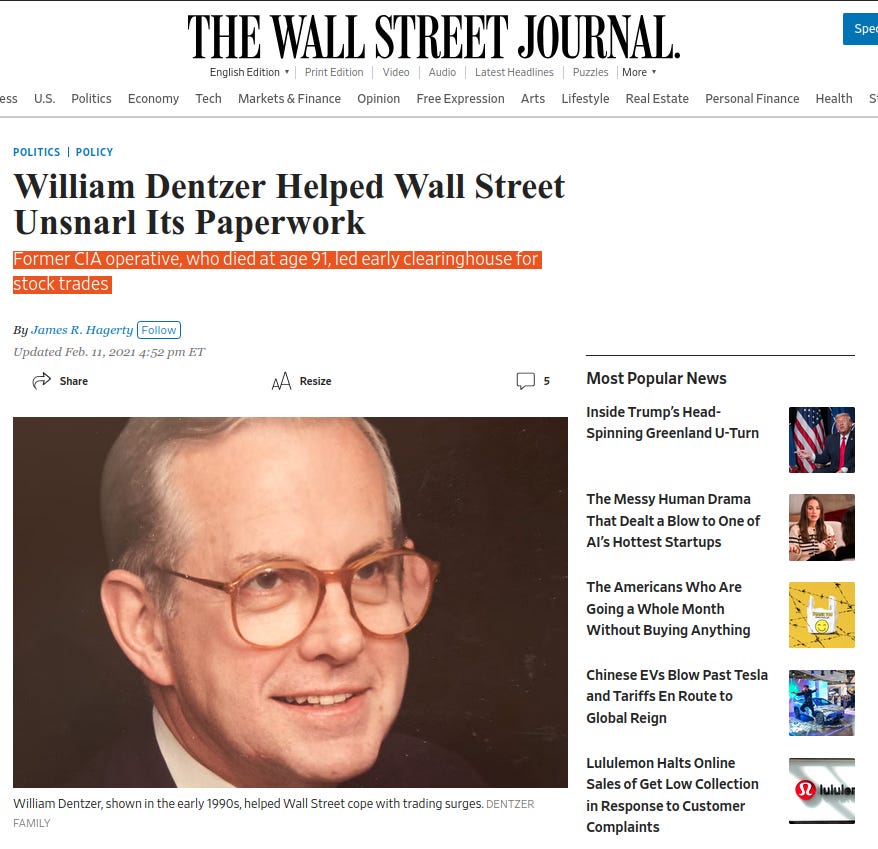
The construct of the securities entitlement (that you have a claim-on-a-claim, not direct property) was put into Uniform Commercial Code (UCC) and pushed through all 50 states in 1994.
It took them ~10 years to get it done in all 50 states.
Then they changed the bankruptcy law in 2005 and tested it in the 2008 crisis.
Then they began a process of harmonization to force the law globally and today there are no exceptions.
The Controllers have put in all this work over decades and decades to ensure that people everywhere in the world don't directly own their assets and if the system fails, everyone gets rugged.
With that in mind, here is my ranking of Great Taking hedges.
Rank #1 — Your own human capital & health
Why it’s #1:
Cannot be seized by ledger rewrite.
Survives regime, currency, and legal resets.
Converts into value in any system: skills, judgment, psychological resilience, ability to learn and pivot.
In a collapse/Great Taking, people who can solve hard problems under stress become scarce.
Examples of high-value human capital:
Hard technical skills: engineering, security, data/AI, mechanical/electrical, medicine.
Operational skills: logistics, repair, energy, food systems, local manufacturing.
“Meta” skills: negotiation, reading incentives, building & leading teams, learning fast.
Why the Controllers can’t fully touch it:
They can conscript, regulate, and channel it — but they can’t zero it out with a keystroke the way they can a brokerage balance.
Downside:
Not immediately liquid.
Requires you to stay physically safe and mentally stable.
Conclusion:
In any Great Taking scenario, your fast-adaptable skill stack is the single most robust hedge. Everything else is secondary.
Rank #2 — Self-custodied, bearer digital assets (e.g. BTC, Monero)
Very specifically:
Bitcoin (spot, in self-custody, with good OPSEC) – not on exchanges, not in ETFs, not with a custodian, not in a corporate treasury wrapper.
You actually control the keys; no counter-party can be ordered to confiscate or freeze for you.
Why it ranks this high:
Not a claim on anyone’s balance sheet; a bearer digital good.
Hardest for a single legal regime to seize at scale, especially if:
Keys are geographically/jurisdictionally dispersed.
You avoid KYC-visible on-ramps as much as possible in your jurisdiction.
Under a Great Taking, everything inside the system is a soft target. A self-custody bearer asset is outside that seizure path.
How it can still be attacked:
Off-ramps (exchanges, banks) can be throttled or criminalized.
Nodes/pools can be regulated; Medium-of-Exchange usage can be framed as suspicious or taxed to death.
You can be targeted personally if they know you hold it (data leaks, chain analysis, KYC records).
Forcing you to re-inter the asset into a CBDC/tax regime (amnesty windows, wealth levies, “declare or else” laws).
Why it’s still a hedge:
Even if usage is pushed into a grey market, under extreme systemic stress anything that cannot be printed or bailed-in is valuable.
In a true expropriation of deposits/securities, a small position can reprice massively vs. system assets.
Key distinctions:
Self-custody BTC/Monero = potential protection against expropriation.
ETFs / futures / corporate BTC treasuries = likely inside the seizure perimeter (they are just another custody claim in the system).
Rank #3 — Physical precious metals under direct control
Very specifically:
Physical gold and silver in your direct possession or in very conservative, low-friction arrangements (e.g., non-levered allocated storage you could realistically access or move).
Why it ranks high:
Historical track record as a money-of-last-resort in systemic crises.
No credit/issuer risk if you physically hold it.
Behaves as a hedge against currency collapse and trust in sovereign promises.
How it can be attacked:
Confiscation orders (Order 6102-style): you’re told to sell it to the state or holding becomes illegal.
Enforcement will be uneven: big visible hoards (banks, ETFs, large vaults) are easy; small private holdings are much harder but can still be pressured via:
Reporting rules.
Search-and-seizure in targeted cases.
Making it hard to transact (no legal markets, harsh reporting on gold trades).
Why it’s still a hedge:
Confiscation is expensive to fully enforce; the more diffuse and small-denomination your holdings, the harder it is to police.
In a cross-border / inter-regime context, gold is often accepted when fiat trust is gone.
Trade-offs vs. BTC:
BTC: weightless, easier to move across borders, more visible on public ledgers, more dependent on digital infrastructure.
Gold: heavy, physical, less tied to digital rails, but easier to identify and physically seize if you become a target.
Rank #4 — Unencumbered, productive real assets you directly control
Examples:
Land with water/food potential, owned free and clear (no mortgage).
Small-scale, productive physical business (workshop, farm, repair shop etc.).
Essential tools/equipment (energy, fabrication, maintenance).
Why it’s valuable:
Even in a seizure-heavy regime, production is still needed: food, repair, local services.
Assets that generate direct utility (food, shelter, energy, repair) give you bargaining power.
If highly localized and not massively leveraged, they’re less attractive for blanket “financialized” seizure.
How they can still be hit:
Property tax hikes → de facto wealth tax / forced sales.
Eminent domain / zoning / environmental rules.
Forced “climate/ESG” compliance that makes your operation expensive or illegal.
In a true Great Taking, property registries themselves can be weaponized.
Why it’s still a hedge:
They cannot centrally administer everything equally.
Small-to-mid-scale, non-flashy productive assets in non-core locations tend to be lower-priority targets.
Even if partially taxed/regulated, they still give you local leverage and survival capacity.
Rank #5 — Jurisdictional Optionality (residency / passports / banking diversification)
What this really is:
The ability to physically and legally move yourself and some capital between regimes.
Why it matters:
Great Taking is rarely perfectly synchronized globally; there are laggards, outliers, and places where enforcement is weaker or slower.
Regulatory arbitrage still exists: some states will prefer to attract capital/skills fleeing more aggressive expropriators.
Forms:
Second residency / citizenship.
Multiple banking relationships in different legal systems.
Connections that allow rapid re-domiciling of self and, where legal, some assets.
Limitations:
In a true full-spectrum coordinated taking, even foreign accounts can be pressured (sanctions, FATCA/CRS-style data sharing, global standards).
In crisis, borders can tighten quickly; moving late can be impossible.
Still often involves custodial assets (which are seizable there too).
Why it still makes this list:
Even in highly coordinated regimes, enforcement capacity and political priorities differ.
Having viable options outside a single legal perimeter gives you room to pivot when rules change.
Rank #6 — Physical cash & high-liquidity barterable goods
Physical cash:
Useful in the transition window when digital rails are unstable or distrusted.
Helps bridge from “old system seizure” to whatever comes next.
But:
In a true Great Taking, cash can be:
Demonetized (new notes; old ones invalid).
Forced-converted into CBDC (deposit deadlines).
Eroded by high inflation.
So:
Good short-duration hedge, weak long-duration hedge.
Barterable goods:
Fuel, food, basic meds, critical spare parts, comms gear.
Not “investments” per se, but reduce dependence on seized systems at critical moments.
Rank #7 — Unregistered tangible value (collectibles, tools, durables)
Examples:
Quality tools, machinery, bikes, non-registered vehicles, certain art/watches/collectibles that aren’t on centralized registries.
Items that:
Hold value decently.
Are not tightly linked to a central ledger.
Can be sold/used locally.
Why it’s on the list:
Harder to centrally census and seize at scale.
In distress, certain categories retain strong black/grey market demand.
Limitations:
Less divisible than BTC/gold.
Some may become hard to trade in a crackdown.
Values can be highly cyclical (luxury collapses; practical goods rise).
Rank #8 — Pensions, annuities, insurance claims (Negative hedge)
Including for completeness as anti-hedges:
They are pure system promises.
In a Great Taking, these are prime candidates for:
Haircuts.
Benefit “reforms”.
Indexation games.
Forced conversion to CBDC-based entitlements.
Why some might still hold them:
They’re often mandatory or tax-advantaged.
Many people have no choice or no other assets.
But as a hedge, they are near-zero:
You are explicitly on the wrong side of the balance sheet.
Rank #9 — Paper claims on “hard things” (ETFs, commodity funds, treasury companies)
Again, mostly as anti-hedges for this scenario:
Gold ETFs, commodity funds, BTC ETFs, mining equities, “commodity-backed” structured products.
From a Great Taking perspective, these are:
Just more paper in the system.
Perfectly visible.
Extremely easy to freeze, haircut, or convert.
They may perform well before the real expropriation moment (price action leading up to crisis), but at the point of legal seizure they are the first in line.
Summary rank (condensed)
If the axis is: “How much survives a global, legally engineered seizure of collateralized/ledger-visible assets?”, my ranking is:
Human capital & health
You, your skills, your adaptability.
Self-custody BTC, Monero (keys you control, good OPSEC)
Bearer, borderless, outside the usual custodial seizure channels.
Physical precious metals in your possession
Historical crisis hedge; seizure possible but expensive/incomplete.
Unencumbered productive real assets you directly control
Especially those that produce food, energy, repairs, or local services.
Jurisdictional optionality (residency / citizenship / multi-banking)
Not bulletproof, but buys time and alternative legal contexts.
Physical cash + key barter goods
High utility in transition; poor long-term hedge against systemic redesign.
Unregistered tangible value (tools, useful equipment, low-visibility collectibles)
Harder to centrally seize; good for local resilience.
Pensions/annuities/insurance claims
Prime expropriation targets; negative hedge in this scenario.
Paper claims on hard things (ETFs, commodity funds, BTC ETFs, treasury BTC, etc.)
May do well on the way to crisis; likely not yours in a true Great Taking.
How to actually think about this
Don’t think “which single magic asset saves me?”
Think portfolio of different seizure surfaces:
Some edge (self-custody BTC, metals).
Some off-grid survival (skills, productive real assets, tools, network).
Some jurisdictional optionality (so you aren’t locked in one perimeter).
Don’t underestimate timing:
System doesn’t go from “everything normal” → “Great Taking executed” in one tick (I think).
Crises, pilot bail-ins, regulatory “reforms”, narrative pivots = warning flares.
The more you prepare before those, the less you have to panic during.
And remember:
The Controllers’ constraint is not “fairness”; it’s cost of control vs. legitimacy vs. state survival.
Hedges that are:
Hard to centrally count,
Hard to centrally confiscate,
And yet easy for you to use or move, sit in their blind spots.
Based on the research I’ve done, I don’t think any single hedge is absolute.
However, if you look historically, the ones who were self-sufficient (e.g. lived on a farm) during the Great Depression, Weimar Germany, and any other artificially-created crisis were the ones who were impacted the least.
It’s almost like the Amish and the people of Zomia are onto something.
Couldn't agree more, this is a truly insightful breakdown; what do you see as the biggest regulatorry challenges for this across the EU, you're so smart!