

In a recent video, Francis Hunt referred to oil as the “Rockefeller tax“, “tax dial“ and “the financial weapon of mass destruction that masquerades as an ordinary commodity”.
In this article, I’ll cover how the Controllers use oil to:
extract purchasing power invisibly,
discipline labor and weaker states,
create inflation justification,
trigger asset repricing,
consolidate ownership,
and preserve optionality for the eventual patch/reset.
The clean way to think about oil is this:
Oil is not just a commodity.
It is the broadest, fastest, least-voted-on tax lever in the system.
The Controllers don’t perfectly control every tick. They control the price corridor, the timing, the narrative, and the pass-through.
1. Why oil is the perfect hidden tax dial
Oil is uniquely useful because it sits upstream of almost everything:
transport,
agriculture,
mining,
chemicals,
plastics,
shipping,
aviation,
diesel backup power,
military logistics,
construction,
emergency response,
food distribution.
So when oil rises, the public does not experience it as “oil rose”.
We experience it as:
fuel rose,
food rose,
freight rose,
airline tickets rose,
packaging rose,
fertilizer rose,
heating and backup-power costs rose,
then everything else rose with a lag.
That makes oil different from, say, copper or lumber.
Oil is the tax dial because it:
reaches everyone,
hits quickly,
is hard to avoid,
is regressive,
and gets blamed on “markets”, “wars”, “greed”, or “unexpected events” instead of on a direct policy choice.
If you are trying to extract purchasing power from a population without openly voting for a tax increase, oil is almost ideal.
2. Oil taxes behavior without legislation
The beauty of oil is that it behaves like a tax that:
does not need parliamentary approval,
does not show up on a clean line item,
can be blamed on foreigners, cartels, speculators, weather, pipelines, war, or “global supply-demand”,
and can be selectively reversed when politically necessary.
So oil is useful because it lets the Controllers do four things at once:
1) Extract disposable income
households spend more on essentials,
less remains for discretionary consumption,
private-sector demand cools without an explicit austerity vote.
2) Discipline labor
people under energy/food stress become more job-dependent,
strike appetite falls,
mobility falls,
tolerance for shitty real wages rises because survival takes priority over bargaining.
3) Reprice assets
high oil feeds inflation,
inflation feeds rate pressure,
higher rates hit duration and leverage,
the sacrifice layer gets squeezed.
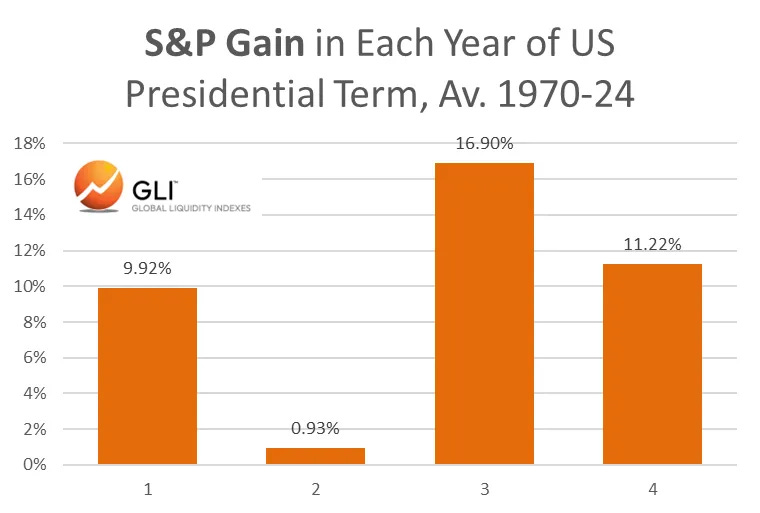
We are currently in the discipline <by default> year (midterm year).
4) Reallocate wealth upward and outward
from consumers to producers,
from importers to exporters,
from weak countries to hard-currency/commodity powers,
from households to states and systemically important firms.
That is why oil is more than an inflation input.
It is a transfer mechanism.
3. How the Controllers actually use it
They don’t need to omnipotently set every daily price.
They do it by shaping the conditions that determine where the floor, ceiling, and panic zone sit (control the price corridor).
The main methods are these:
A) Supply throttling by under-investment
The cleanest long-game way to weaponize oil is not to “cut supply tomorrow”.
It is to make future supply structurally tight.
How:
suppress capex,
slow permitting,
raise financing costs for drilling and infrastructure,
stigmatize long-lived fossil projects,
create legal and ESG uncertainty,
keep boards terrified of over-investing,
punish boom-bust expansion cycles.
Result:
the world runs on oil it pretends it has morally outgrown,
spare capacity shrinks,
the system becomes fragile,
small disruptions create large price effects.
This is superior to a sudden embargo because it looks like:
market discipline,
climate policy,
shareholder prudence,
or “capital efficiency”.
But functionally it creates an energy scarcity premium that can be turned into a macro tax later.
B) Producer coordination and tolerated cartel behavior
Oil producers do not need to maximize volume.
They maximize geopolitical and financial utility.
That means:
restrict supply when inflationary pain or geopolitical pressure is desired,
loosen supply when recession risk or electoral risk gets too high.
Public story:
OPEC,
national interest,
budget needs,
technical maintenance,
demand uncertainty.
Real function:
price corridor management.
The trick is not stable cheap oil.
The trick is oil expensive enough to extract and discipline, but not so expensive that it detonates the core system too early.
C) Sanctions and selective exemptions
Sanctions are one of the dirtiest oil-control tools because they simultaneously:
remove barrels,
re-route trade,
widen freight and insurance costs,
create price dispersion,
and justify emergency state powers.
But total removal is often not the actual goal.
Better is selective restriction:
enough to raise marginal supply stress,
not enough to completely collapse the target or crash the global system.
Even better:
loudly sanction,
quietly exempt,
create waiver regimes,
allow shadow shipping,
let middlemen take cuts,
keep the system tight and opaque.
This gives maximum control and minimum clarity.
D) Strategic reserve releases and refills
Strategic reserves are basically macro-political smoothing tools.
They allow the Controllers to:
lean against spikes before elections,
calm panic after wars or embargo news,
buy time for diplomacy or military positioning,
and later refill in quieter conditions, often supporting the floor.
So the reserve is not just emergency insurance.
It is a political volatility buffer.
It lets them say:
“we are protecting consumers”,
while actually managing the timing of pain.
E) Futures, paper markets, and narrative-assisted price discovery
Oil is not just physical barrels.
It is a huge paper market.
That matters because:
futures set forward expectations,
forward expectations alter producer hedging and investment,
risk desks, margin rules, and ETF/speculator flows can exaggerate or suppress moves,
headlines and positioning can create self-reinforcing squeezes.
So if you can influence:
who gets margin,
who gets warehousing,
who gets credit,
what narrative dominates,
what geopolitical rumor gets oxygen,
you do not need perfect control of supply.
You can shape the price path enough to get the macro effect you want.
F) Chokepoints, insurance, and shipping friction
A barrel is not useful just because it exists.
It has to move.
So oil pricing power is also:
tanker insurance,
sanctions enforcement,
port access,
canal/strait risk,
naval protection,
shipping compliance,
payment-clearing permission.
By increasing transport and insurance friction, the Controllers can create an effective oil tax without changing the headline crude benchmark all that much.
This is especially important because the public tends to watch the crude price while the real pain often comes through:
diesel,
jet fuel,
freight rates,
regional product shortages.
G) Refining bottlenecks and product spreads
Crude is only half the game.
The actual social pain often comes from refined products.
If you want public anger fast:
squeeze diesel,
squeeze gasoline,
squeeze heating oil,
squeeze jet fuel.
This can happen even if crude itself is not at historical extremes.
Why this matters:
diesel is the bloodstream of heavy economy,
trucking, farming, construction, mining, backup generation, shipping all feel it fast.
So the Controllers using oil as tax dial is really using the full chain:
crude,
refining capacity,
product inventories,
logistics,
retail pass-through.
H) Dollar policy
Because oil is entangled with the dollar system, the real tax is often:
oil price x dollar strength.
A country can survive higher oil in local terms if its currency is strong.
It gets wrecked if:
oil is up,
dollar is up,
capital is leaving,
refinancing costs are up.
So oil control and dollar-liquidity control amplify each other.
That is where oil becomes truly destructive:
imported inflation,
FX weakness,
rising sovereign stress,
forced tightening,
recession,
asset sales.
Oil alone hurts.
Oil plus dollar scarcity kills.
4. What the Controllers’ incentives are
The incentive stack is pretty straightforward.
A) Hidden taxation
This is the most basic.
Higher oil:
drains household cash flow,
lowers real wages,
cools demand,
raises nominal tax receipts in some systems,
enriches energy-linked states and politically connected sectors,
and does it all with less visible blame than direct taxation.
It is austerity with plausible deniability.
B) Inflation management through fear, not precision
This sounds contradictory, but it is not.
The Controllers do not necessarily want permanently high inflation.
They want an inflation environment they can use.
Oil is perfect for this because it lets them:
scare the population with inflation,
justify tighter money or emergency measures,
crush weaker balance sheets,
then later relieve the pressure and claim success.
In other words:
oil is a trigger, not just a level.
C) Sectoral discipline
High oil punishes:
low-margin consumers,
transport-heavy sectors,
weak importers,
leveraged discretionary businesses,
fragile governments.
It rewards or protects:
commodity exporters,
military-industrial structures,
energy majors,
hard-asset holders,
security states that can justify more intervention.
So oil is not neutral pain.
It is selective pain.
D) Geopolitical ranking
Oil pressure quickly reveals:
who has spare capacity,
who has strategic reserves,
who can subsidize consumers,
who can tolerate current-account deterioration,
who must beg for swap lines or IMF help.
That makes oil a very efficient hierarchy-revealer.
E) Consent management
The Controllers can use oil in a cycle:
first, let pain build,
then intervene theatrically,
then claim to have “protected the people”,
then ask for more surveillance, more industrial policy, more war spending, more strategic coordination, more emergency powers.
Oil pain is socially legible.
That makes it politically useful.
F) Asset consolidation
Because oil feeds inflation and tightening pressure, it is a great way to crack the weak hands before a rescue.
High oil can help trigger:
consumer stress,
small business failures,
Emerging Market blowups,
credit widening,
equity derating,
real-estate softness,
pension and sovereign stress.
Then the patch comes.
Then assets are cheaper.
Then ownership consolidates further upward.
5. Why oil is a “financial weapon of mass destruction”
Oil is one of the fastest ways to transmit systemic stress into every layer of the economy.
Why it is so destructive:
A) Low short-term elasticity
people cannot instantly stop commuting,
farmers cannot instantly stop using diesel and fertilizer,
airlines cannot instantly stop needing jet fuel,
militaries cannot run on vibes.
So price rises do not just reduce consumption cleanly.
They first reduce disposable income (the real goal) and increase stress.
B) Oil sits upstream of food
fertilizer,
pesticides,
farm machinery,
irrigation energy,
transport,
refrigeration.
So oil shocks become food shocks.
Food shocks become legitimacy shocks.
C) Oil drives inflation expectations
ordinary people do not model core PCE (Personal Consumption Expenditures).
they see:
gasoline,
diesel,
grocery bills,
heating.
that shapes wage demands, political rage, and central-bank credibility.
D) Oil forces monetary reactions
even if central banks pretend to “look through” oil,
the second-round effects become hard to ignore.
then:
yields rise,
discount rates rise,
refinancing pressure rises,
So oil is not just inflationary.
It is a lever that can force the financial system into a more brittle rate/liquidity regime.
E) Oil wrecks importers asymmetrically
Europe, Japan, many Emerging Markets, manufacturing importers, tourism-dependent states, poor households — they all get squeezed differently, but hard.
exporters and security providers gain relative leverage.
F) Oil can create both inflation and recession
that is what makes it so nasty.
it can simultaneously:
raise prices,
reduce growth,
pressure currencies,
compress margins,
and destabilize politics.
That combination is systemically ugly because it narrows policy options.
It is very hard to solve:
inflation without recession,
recession without reflation,
reflation without FX stress.
Oil jams the machine.
6. The political beauty of oil: it looks external
One reason oil is such a favored lever for the Controllers is that it appears to come from outside domestic politics.
That gives our puppet leaders a ready-made alibi:
foreign dictators,
wars,
terrorists,
speculators,
greedy oil companies,
pipeline outages,
refinery accidents,
weather,
“global conditions”.
So even when domestic “elites” helped create the fragility:
under-investment,
regulatory contradictions,
reserve mismanagement,
sanctions design,
shipping restrictions,
monetary excess,
they can still present the pain as imported fate rather than regime choice.
This is extremely valuable.
A VAT (Value-Added Tax) hike is clearly the government taxing you.
A fuel-price spike feels like tragedy.
That difference matters enormously for legitimacy.
If you deplete legitimacy too much, your costs of control rise.
7. The ideal control pattern
The Controllers’ target is not “highest possible oil”.
It is “highest politically useful oil”.
That usually means:
high enough to extract and discipline,
high enough to justify inflation-fighting and security measures,
high enough to weaken fragile players,
but not so high that:
core consumer revolt becomes unmanageable,
allied governments collapse,
banking and pension stress detonates too soon,
demand destruction crashes the whole thing before consolidation is ready.
So the goal is often a ratchet, not a moonshot.
Pattern:
slow squeeze,
episodic spike,
theatrical relief,
partial normalization at a higher baseline.
That is how you tax without admitting you taxed.
8. What this means across different actors
A) For households
Higher oil means:
lower real disposable income,
more forced dependence,
more debt usage,
more willingness to accept subsidies and digital control in exchange for stability.
Oil pressure can turn nominally independent citizens into administratively manageable subjects very quickly.
B) For businesses
High oil punishes:
low-margin,
high-transport,
energy-intensive,
inventory-heavy,
weakly financed firms.
It favors:
scale,
political access,
balance-sheet strength,
vertically integrated firms,
firms able to pass through costs,
firms considered systemically useful.
So oil accelerates consolidation.
C) For states
Importers:
get inflation,
current-account stress,
weaker currencies,
higher subsidy burdens,
political unrest.
Exporters:
gain revenues,
leverage,
geopolitical importance,
bargaining power.
But exporters also become tools and targets in the wider game.
D) For central banks
Oil shocks trap them.
If they ease into an oil shock:
they risk currency weakness and inflation optics.
If they tighten into it:
they worsen debt/liquidity fragility.
That is why oil is such a good coercive dial.
It reduces optionality.
E) For asset markets
Higher oil:
compresses equity multiples,
punishes consumer cyclicals and junk,
stresses credit,
increases macro vol,
pressures housing through rates and disposable income,
can temporarily hit even hedges as dollars are raised.
Again: oil does not just “cause inflation”.
It changes the whole financial weather.
Oil is one of the fastest ways to move from:
complacency,
to
inflation anxiety,
tightening,
asset pain,
emergency patch,
new rules.
9. The public story vs the real function
Public story:
oil is just a volatile commodity,
shocks are unfortunate,
leaders are trying their best,
price changes reflect uncontrollable global complexity.
Real function:
oil is a distributed extraction mechanism,
a demand-destruction lever,
a geopolitical ranking device,
a trigger for monetary tightening and debt stress,
and a legitimacy-management tool.
That is why the rhetoric around oil is always so moralized and theatrical.
They need the public to see:
villains,
accidents,
greedy producers,
heroic reserve releases,
difficult but necessary policy.
They do not want people to see oil for what it is:
one of the cleanest hidden taxation and discipline tools available to a modern system.
10. TL;DR
The Controllers use oil as a tax dial by managing the corridor of scarcity, not by perfectly controlling every price print.
They do it through:
under-investment,
shipping and insurance friction,
producer coordination,
sanctions and waivers,
reserve releases/refills,
refinery/product bottlenecks,
futures/plumbing influence,
and dollar-liquidity interaction.
Their incentives are:
extract purchasing power invisibly,
discipline labor and weaker states,
create inflation justification,
trigger asset repricing,
consolidate ownership,
The implication is that oil is not merely “an input cost”.
It is one of the most efficient system-wide coercion levers because it hits:
households,
firms,
currencies,
inflation,
rates,
and sovereign stability
all at once.
That is why oil really does function like a financial weapon of mass destruction:
not because it instantly destroys everything,
but because it can propagate stress through every major transmission channel in the system faster than almost any other non-military lever.
More context: